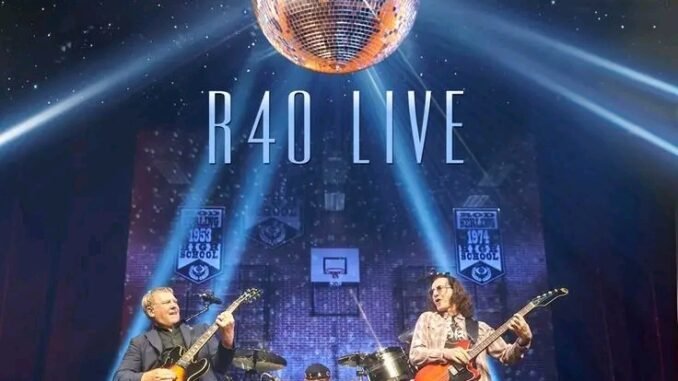
Rush Returns in Full Force: “R40 Live” Shines With Iconic Performance and Timeless Energy
The long arc of Rush’s career has always felt like a comet—bright, unhurried, and entirely indifferent to the gravitational pull of musical fashion. R40 Live, the celebration of the band’s fortieth anniversary tour, captures that luminous streak at the moment before it dipped beyond the horizon. What emerges is not merely a live album or concert film, but a kind of sonic time capsule: a document of three musicians revisiting every evolutionary branch of their sound while maintaining the rare clarity of purpose that made them legends.
Recorded over two nights in 2015 at the Air Canada Centre in Toronto, R40 Live arrives with the satisfying crackle of a homecoming. The crowd’s roar has the texture of a city welcoming back its favorite lunar explorers. After decades of global wandering—from the sci-fi fortresses of 2112 to the philosophical clockwork of Moving Pictures and the stadium-sized adrenaline of Clockwork Angels—Rush returned to their birthplace to stage one final, monumental retrospective.
What made this tour extraordinary, both structurally and emotionally, was its reverse-chronology concept. Most bands march forward through their catalog; Rush decided to stroll backward. Each section of the show peeled away a layer of their musical evolution, like archaeologists excavating the band’s own creative strata. The concert begins in the dense, modern machinery of “The Anarchist” and “Headlong Flight,” with Alex Lifeson’s guitars firing off geometric riffs, Geddy Lee’s bass prowling with improbable agility, and Neil Peart building rhythmic architecture that feels both mathematical and strangely organic.
As the setlist rewinds toward the band’s 1980s synthesiserscapes, R40 Live reveals something often overlooked in their reputation for precision: lightness. There is wit in the arrangements, elasticity in the playing, the kind of camaraderie formed only by a band that has spent four decades finishing one another’s musical sentences. Geddy Lee leans into the playful neon of “Subdivisions” and “Red Sector A” with renewed vitality. Lifeson, ever the sonic tinkerer, paints the air with textural shimmer one moment and snarling riffs the next. Peart delivers complex patterns with the serenity of a calligrapher—each stroke deliberate, unhurried, unfailingly articulate.
The middle of the show becomes a gateway into the classic era, hitting Permanent Waves and Hemispheres with tidal force. “The Spirit of Radio” leaps out still crackling with philosophical defiance, its mosaic of reggae drops and hard-rock blasts perfectly intact. “Natural Science,” that sprawling, tide-pool meditation on chaos and order, feels like a miniature symphony—proof that Rush’s curiosity never dulled, only deepened. Here, the band taps into its signature equilibrium: cerebral but never cold, intricate but never self-indulgent, emotional without resorting to theatrical swelling.
One of R40’s quiet triumphs is its production. The recording preserves the band’s muscularity without sanding down the human edges. Strings buzz. Cymbals breathe. You can hear the space in the room, the collective inhale before a rhythmic plunge. It’s rare for a live document to be both polished and alive, but this one manages it, like a museum exhibit that still growls if you lean in close.
The stage design acts almost like a second narrative voice. As the setlist moves backward through time, the props and backdrops also devolve. Elaborate gear gives way to the simpler rigs of earlier tours. By the time they reach “Lakeside Park” and “Anthem,” the stage resembles a garage—almost as if the band were inviting the audience into the memory-palace where everything began. This visual regression becomes unexpectedly touching, a reminder that even titans once played tiny rooms with borrowed amps and the ferocious optimism of youth.
And then the portal opens to 1976. “2112” remains the monolith of Rush’s mythology, a piece so embedded in rock history that performing it might risk turning into ceremony. But here it arrives with the kind of voltage normally reserved for opening nights. Geddy’s high passages cut through the air with the assurance of someone who refuses to treat their younger self as impossible. Lifeson’s leads are urgent, almost impatient, as though the guitar has its own opinion about destiny. Peart’s drumming radiates thunder—less a beatmaker than a storyteller using toms and cymbals as punctuation in an epic cosmic argument.
Yet R40 Live becomes most poignant in its closing minutes. After the grandeur of their prog epics, the band steps all the way back to “What You’re Doing” and “Working Man,” dusting off their bar-band origins. The music is raw, loud, a little scruffy at the edges—in a good way. It reminds the listener that beneath the philosophical lyrics and labyrinthine time signatures, Rush was always fueled by the elemental joy of making noise together. There’s something beautifully circular in ending the night with the roar of their earliest material: the comet returning to the point where its orbit began.
What lingers after the final applause isn’t nostalgia, but continuity. R40 Live doesn’t mourn the passing of an era; it crystallizes the absurd miracle that the era lasted so long—and evolved so widely—without losing its center. Rush’s ability to grow without shedding their identity is on full display, like a tree gaining rings but never losing the rhythm that shaped it.
For longtime fans, R40 Live is a gift, a closing chapter written with affection rather than decay. For newcomers, it’s a compressed mythology—forty years of musical exploration mapped into one soaring, breathless document. And for the band, it stands as proof that they left not with a fade-out, but with a flourish: a final blaze of progressive fire before stepping off the stage and into legend.
In the end, R40 Live feels less like a farewell and more like a constellation. The music doesn’t vanish when the show ends; it hangs above, still shimmering, waiting for anyone who needs a guide star.
Leave a Reply