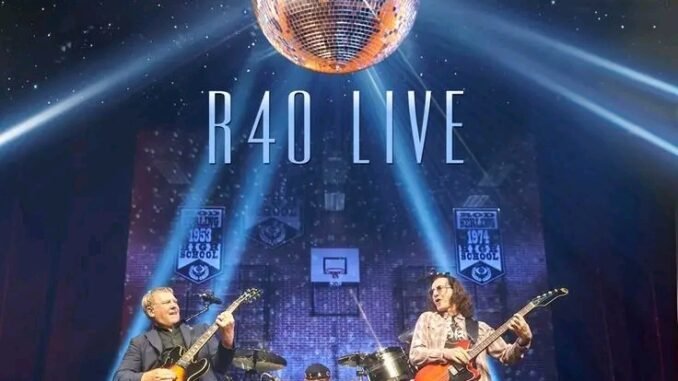
Legends in Motion: Rush’s R40 Live Captures 40 Years of Unmatched Musical Power
Few bands in rock history have carved a legacy as deep, precise, and fiercely loyal as Rush. For four decades, the Canadian trio—Geddy Lee, Alex Lifeson, and Neil Peart—reshaped what rock music could be, welding progressive ambition with arena-level force and unmatched technical mastery. In 2015, their monumental R40 Live tour arrived not just as another series of concerts, but as a full-circle celebration of their extraordinary 40-year journey. What emerged is now considered one of the most ambitious and emotionally resonant live releases ever produced by a rock band. R40 Live is more than a concert film—it is a time capsule, a tribute, and a living museum of Rush’s evolution.
The magic of R40 Live begins from the moment the house lights fall and the band steps into the roar of the Toronto crowd. There is a sense of homecoming, of legacy being honored by the very audience that grew with them through every era—from the heavy riffs of the early 1970s to the synthesizer-rich explorations of the 1980s and the renewed hard-rock energy of the 2000s. What makes this performance extraordinary is not just its meticulous musicianship, but the way the show literally moves backward through time. Instead of moving forward through a linear setlist, Rush constructed a reverse-chronological journey, rewinding their own history with theatrical flair.
The concert opens with modern-era tracks like “The Anarchist” and “Headlong Flight,” showcasing that even in their sixties, the band’s energy remained volcanic. Geddy Lee’s voice, though naturally matured with time, is expressive and commanding; his bass lines, still some of the most inventive in rock, crackle with freshness. Alex Lifeson’s guitar tone swings from majestic to ferocious with effortless fluidity. And Neil Peart—always the band’s gravitational center—drives everything with thunderous clarity, his drumming a blend of machine-like precision and human intensity.
As the show progresses, the stage evolves in a brilliantly playful way: elaborate lights and digital screens give way to older amplifiers, retro backdrops, and vintage gear. By the time Rush reaches their late ‘80s and early ‘90s catalog—tracks like “Roll the Bones” and “Subdivisions”—fans are not merely hearing songs; they are stepping into the past with the band as their guides.
One of the emotional high points arrives with “Closer to the Heart,” a timeless anthem performed with renewed warmth. The audience’s collective voice rises like a choir, reflecting how deeply Rush’s music has embedded itself into generations of listeners.
Peart’s drum solo—long considered a cornerstone of any Rush live experience—is jaw-dropping in R40 Live. Here, it feels particularly significant. With rhythmic motifs, complex polyrhythms, jazz interludes, and electronic textures, Peart delivers a performance that is both a technical masterclass and a farewell love letter to his craft. Knowing now that he was battling physical pain during this era, and that he retired soon after, the solo carries a quiet nobility. It is the sound of an artist giving everything he has left and summoning brilliance one more time.
As the concert continues its descent through the decades, Rush restores older and older layers of their sonic identity. When the band reaches their Permanent Waves and Hemispheres era, the crowd reacts with visceral nostalgia. Songs like “The Spirit of Radio” and “Jacob’s Ladder” unfold with cinematic grandeur. Lifeson’s guitar textures shimmer with an almost ethereal quality, while Geddy navigates complex keyboard-bass multitasking with remarkable finesse.
And then comes the moment many fans call the emotional core of the show: the band stepping into their true 1970s prog-rock heart. “Xanadu,” with its sweeping narrative and labyrinthine structure, becomes a highlight of the evening. Watching three musicians create a soundscape so massive, so intricate, and so alive remains one of the great wonders of Rush’s legacy.
The final act of R40 Live is both humorous and heartfelt. The stage transforms again—this time all the way back to the early club days. The amps shrink. The lighting dims. Roadies in vintage Rush T-shirts wheel out small, old-school gear. For the encore, Rush performs “Working Man” in its raw, blues-infused 1974 spirit—a pure, unfiltered origin story. In these closing minutes, the band strips away all spectacle, leaving only three friends playing the music that started everything.
The concert ends not with bombast, but with authenticity. The screen fades, leaving a profound sense of gratitude—for the band’s art, for Peart’s brilliance, for the friendship that held them together, and for the fans who stood by them for 40 transformative years.
R40 Live stands today as a monument. It captures Rush in their final touring form, still pushing boundaries, still delivering excellence, still proving that complexity and heart can coexist in rock. It is a celebration of a band whose influence spans countless genres and musicians, and whose music continues to resonate worldwide.
For longtime fans, R40 Live is a masterpiece of remembrance. For new listeners, it is a breathtaking entry point. For all, it is proof that legends do not fade—they evolve, inspire, and leave echoes that last long after the final note.
Leave a Reply