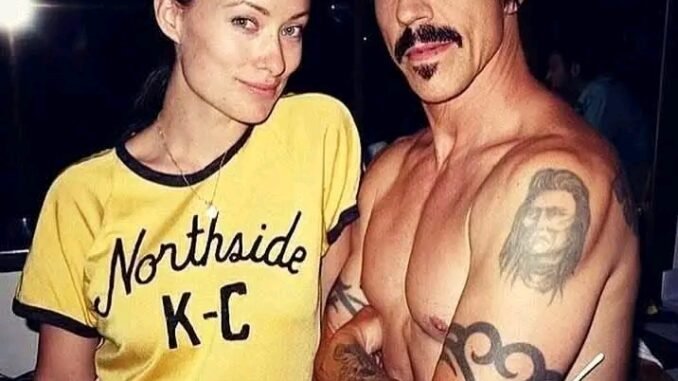
Anthony Kiedis and Olivia Wilde: A Creative Collision Behind “Dark Necessities” (2016)
In 2016, Red Hot Chili Peppers returned with a new wave of creative energy — and at the center of that resurgence was a striking collaboration between frontman Anthony Kiedis and actress-director Olivia Wilde. Their paths crossed during the making of the “Dark Necessities” music video, a project that merged cinematic vision with raw rock emotion. The result was not only one of the band’s most memorable visuals of the decade, but also a moment that captured the enduring artistic curiosity of both Kiedis and Wilde.
Released as the lead single from the band’s 11th studio album, The Getaway, “Dark Necessities” marked a new era for the Chili Peppers. The record, produced by Danger Mouse, signaled a shift from their classic funk-rock roots toward something more reflective, textured, and soulful. The song’s haunting bassline, courtesy of Flea, and its introspective lyrics on addiction, beauty, and self-discovery made it one of the band’s most emotionally resonant tracks. But when it came time to visualize this energy, the group wanted something fresh — a perspective outside the traditional world of rock video directors. Enter Olivia Wilde.
At that point in her career, Wilde had already built an impressive résumé as an actress (House, Tron: Legacy, Her) but was increasingly stepping behind the camera. She had directed a few short projects that demonstrated her eye for movement, color, and character-driven storytelling. The Chili Peppers, known for their adventurous collaborations, saw in her a voice capable of translating the song’s tension between darkness and beauty into something tangible. For Wilde, directing the video was a chance to explore themes of vulnerability and freedom — both of which echoed her own creative journey at the time.
Filmed in Los Angeles, the “Dark Necessities” video was an atmospheric fusion of skate culture and surreal imagery. Wilde centered the narrative around a group of female longboarders carving through the city streets at sunset, their movements fluid and fearless. Interspersed were intimate shots of the band performing in a dimly lit house, with Kiedis delivering his vocals in a way that felt almost confessional. The juxtaposition of liberation and introspection became the heartbeat of the video — an ode to embracing the chaos within oneself.
Behind the scenes, Kiedis and Wilde shared a natural creative rapport. Wilde’s directorial approach was instinctive and performance-driven, encouraging the band to lean into the emotional nuance of the song rather than relying on spectacle. Kiedis, ever the poetic storyteller, found her vision refreshing. “She saw the song in a way that wasn’t literal,” he later reflected in interviews. “She made it about movement, about energy, about the way people carry their pain and joy at the same time.” That synergy elevated the project beyond the usual rock video formula — it became a short film of sorts, echoing the raw emotion that has always defined Kiedis’s lyricism.
Wilde’s visual treatment — blending California sunlight with a moody undercurrent — fit perfectly with The Getaway’s themes. The girls in the video, skating with reckless grace, represented a metaphorical freedom from restraint. Their bruises, laughter, and motion mirrored the contradictions within the human experience: the beauty in imperfection, the necessity of darkness to appreciate the light. This philosophy mirrored the song’s message, which Kiedis wrote as a meditation on confronting one’s flaws and addictions.
Their collaboration also reflected a broader moment in music video culture. By 2016, major artists were increasingly turning to actors and filmmakers from outside the music world to infuse new cinematic life into their videos. Wilde’s involvement, much like Spike Jonze’s or Sofia Coppola’s earlier work in the genre, underscored how storytelling and rock could blend seamlessly when given space to breathe. For Kiedis — who has long championed artistic experimentation — it was the perfect match.
During production, Wilde was known for fostering an open and spontaneous environment. Cast and crew described her directing style as confident yet collaborative, while Kiedis and his bandmates were fully engaged in shaping the tone of each scene. Flea reportedly brought his bass to the set between takes, jamming to maintain the song’s pulse, while drummer Chad Smith kept spirits high with his usual humor. Wilde, meanwhile, paid careful attention to the rhythm of editing — ensuring the visuals flowed like a dance between music and motion.
When the video premiered, fans and critics praised its cinematic feel and emotional depth. It wasn’t just another performance clip; it was a mood piece that expanded the Chili Peppers’ visual identity. Rolling Stone called it “a graceful exploration of chaos,” while NME highlighted Wilde’s direction as “an inspired pairing of youthful rebellion and reflective melancholy.” For Wilde, the project became another milestone on her path toward becoming one of Hollywood’s most promising filmmakers, leading to her acclaimed feature Booksmart three years later.
For Kiedis, “Dark Necessities” was more than just another hit single — it was a reflection of his continued evolution as an artist in his fifties. Through Wilde’s lens, he appeared not as a rock god, but as a storyteller unafraid to explore vulnerability. The video’s success reminded fans that the Chili Peppers’ power lies not only in their energy, but in their willingness to expose the beauty within imperfection.
Nearly a decade later, the collaboration between Anthony Kiedis and Olivia Wilde remains one of the most fascinating intersections of rock and film from the 2010s. It was a meeting of two creative spirits — one a poet of sound, the other a painter of images — who together captured something timeless about the human experience: that within every darkness lies the necessity of light.
Leave a Reply